Retro / Y2K
Bevelled silver chrome, navy title bars and pixel type – "the future" as imagined circa 1998-2003, back on the standard nostalgia cycle.
Read the entryAlso called: Y2K aesthetic · Y2K futurism · Chrome and bubble design
Bevelled silver chrome, navy title bars and pixel type – "the future" as imagined circa 1998-2003, back on the standard nostalgia cycle.
Lineage: The visual language of the actual year 2000, revived roughly two decades later on the standard 20-25 year nostalgia cycle.
Retro / Y2K
Bevelled silver chrome, navy title bars and pixel type – "the future" as imagined circa 1998-2003, back on the standard nostalgia cycle.
Read the entryA working sample – the controls are live (hover, press, focus, the toggle's two states) and everything inside the frame is painted by the token block shown in the recipe below. Nothing saves anything; "Advanced options" jumps to the recipe. The page around the frame stays in Atlas's own system.
#000080#1084d0#c0c0c0#d8d4cc#b0aca4
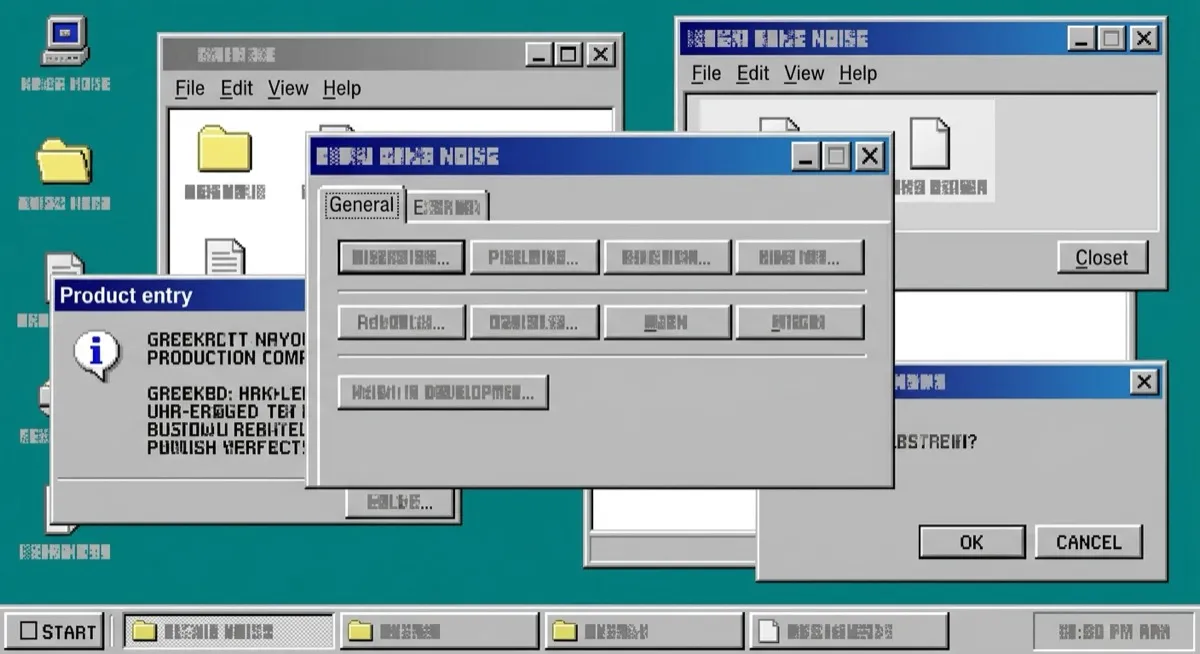
Chrome, gloss, and “the future” as the turn of the millennium imagined it – then a twenty-year wait for it to come back as fashion. Retro/Y2K is distinct from general retro (which can reference any decade) in being anchored to one narrow 1998-2003 window, and the source usefully splits it into three sub-aesthetics worth knowing apart: Windows 95/98 (the bevelled silver chrome the card above wears), GeoCities early-web (marquees, starfields, visitor counters), and Y2K/vaporwave-adjacent (neon, chrome type, gradient mesh – the one most people mean).
The card’s title bar and pixel-type name are the chrome half of the authentic mix; the body copy stays in a plain system sans, because mixing eras is what period interfaces really did.
The standard nostalgia cycle, arriving on schedule. What’s changed in the current wave, per 2025-26 sources: “designers being fluent in Y2K rather than just referencing it” – modern CSS and WebGL produce cleaner chrome and gradient effects than were technically achievable the first time, layered onto contemporary clean grids rather than period-accurate clutter.
Youth-oriented and nostalgia-trading brands, music and entertainment, anything signalling irony, playfulness or generational specificity. Nike shipping a literal Y2K product line is the commercial proof.
Essentially anywhere trust, seriousness or longevity needs signalling. The aesthetic’s entire appeal is reading as dated-on-purpose – the opposite of what most product UI needs. And when briefing: name the sub-style. “Windows 95/98 chrome” is a precise anchor; “retro” alone is ambiguous across at least three visually distinct decades.
Vaporwave – shares the era’s furniture but has a different origin story entirely: music-first, purple-pink-blue rather than silver-chrome-first, and knowingly satirical where Y2K nostalgia is generally sincere. The marble bust is the give-away.
The actual scope from style-scopes.css – the CSS that painted the stage above.
/* ===== style: retro-y2k ===== */
/* Bevelled chrome on silver: outset borders that flip to inset on press,
   navy-to-blue title bars, pixel type for chrome only. */
[data-style='retro-y2k'] {
  --bg-page: #c0c0c0;
  --bg-raised: #d8d4cc;
  --bg-active: #b0aca4;
  --border-default: #4f4f4f;
  --border-hover: #2e2e2e;
  --border-input: #4f4f4f;
  --text-primary: #000000;
  --text-secondary: #2e2e2e;
  --accent-solid: #000080;
  --accent-solid-hover: #0a37b3;
  --accent-text: #00007a;
  --on-accent: #ffffff;
  --radius-s: 0px;
  --radius-m: 0px;
  --radius-l: 0px;
  --shadow-1: 2px 2px 0 #4f4f4f;
  --shadow-2: 3px 3px 0 #2e2e2e;
  --font-sans: Tahoma, 'Segoe UI', system-ui, sans-serif;
}
.sty-card[data-style='retro-y2k'],
[data-style='retro-y2k'] .sty-panel,
[data-style='retro-y2k'] .sty-btn-2 {
  border: 2px solid;
  border-color: #dfdfdf #808080 #808080 #dfdfdf;
}
[data-style='retro-y2k'] .sty-btn {
  border: 2px solid;
  border-color: #dfdfdf #000050 #000050 #dfdfdf; /* navy face keeps the light outset top-left; the taught greys carry the chrome */
}
[data-style='retro-y2k'] .sty-name {
  font-family: 'Silkscreen', Tahoma, sans-serif;
  font-weight: 400;
  font-size: var(--text-lg);
}
/* Vignette: the literal Win95 recipe – navy-to-blue title bar (pixel
   text sits on the navy end: #ffffff on #000080 is 16.0:1, hand-computed
   per CONVENTIONS; decorative and aria-hidden besides), bevelled blocks,
   scanline overlay. */
[data-style='retro-y2k'] .sty-art {
  border: 2px solid;
  border-color: #dfdfdf #808080 #808080 #dfdfdf;
  background: #b8b4ac;
}
[data-style='retro-y2k'] .sty-art::before {
  content: 'STYLES.EXE';
  position: absolute;
  inset: 0 0 auto 0;
  height: 24px;
  padding: 5px 0 0 8px;
  background: linear-gradient(90deg, #000080 0%, #1084d0 100%);
  color: #ffffff;
  font-family: 'Silkscreen', Tahoma, sans-serif;
  font-size: 9px;
  letter-spacing: 0.06em;
}
[data-style='retro-y2k'] .sty-art::after {
  content: '';
  position: absolute;
  inset: 0;
  pointer-events: none;
  background: repeating-linear-gradient(0deg, rgba(0, 0, 20, 0.06) 0 1px, transparent 1px 3px);
}
[data-style='retro-y2k'] .sty-art > i {
  border: 2px solid;
  border-color: #dfdfdf #808080 #808080 #dfdfdf;
  background: #d8d4cc;
  border-radius: 0;
  opacity: 1;
}
[data-style='retro-y2k'] .sty-art .sty-art-a {
  inset: 36px auto auto 12px;
  height: 22px;
}
[data-style='retro-y2k'] .sty-art .sty-art-b {
  inset: 66px auto auto 12px;
  width: 40%;
  height: 22px;
  border-color: #808080 #dfdfdf #dfdfdf #808080; /* pressed – inset flip */
  background: #c8c4bc;
}
[data-style='retro-y2k'] .sty-art .sty-art-c {
  inset: auto 12px 12px auto;
  left: auto;
  width: 30px;
  height: 30px;
  background: linear-gradient(180deg, #1084d0 0%, #000080 100%);
}
/* Hover: the bevel flips outset to inset – the literal Win95 press. */
.sty-card[data-style='retro-y2k']:hover {
  border-color: #808080 #dfdfdf #dfdfdf #808080;
  background: #b0aca4;
  box-shadow: none;
  transform: translate(1px, 1px);
}
/* ===== end retro-y2k ===== */Meant to be copied, not paraphrased – anchors beat adjectives when briefing an agent.
Named links out – the vignettes above are reconstructions, never screenshots (ADR #006).