Web brutalism
Raw HTML shown honestly – zero radius, zero shadow anywhere, default link blue, and a hover that inverts with no transition.
Read the entryAlso called: Brutalist web design
Raw HTML shown honestly – zero radius, zero shadow anywhere, default link blue, and a hover that inverts with no transition.
Lineage: Named by Pascal Deville (brutalistwebsites.com, 2014) – "truth to materials", borrowed from the architecture.
Web brutalism
Raw HTML shown honestly – zero radius, zero shadow anywhere, default link blue, and a hover that inverts with no transition.
Read the entryA working sample – the controls are live (hover, press, focus, the toggle's two states) and everything inside the frame is painted by the token block shown in the recipe below. Nothing saves anything; "Advanced options" jumps to the recipe. The page around the frame stays in Atlas's own system.
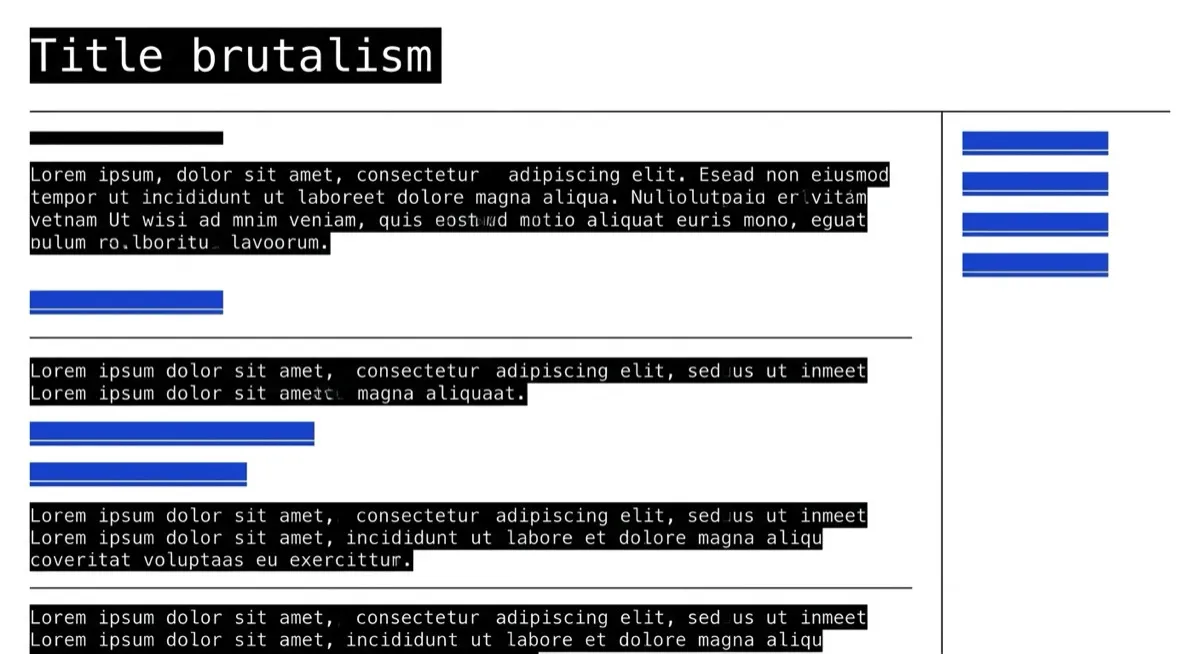
#ffffff#000000#0000eeShow the web page as what it actually is – text, links, borders – with nothing pretending otherwise. Web brutalism takes its name and philosophy from the architecture: raw, unclad concrete, “truth to materials”. Deville’s own framing is the core of it – a reaction “by a younger generation to the lightness, optimism, and frivolity” of template-driven, click-and-drag web design. On the catalogue index, hovering this style’s card inverts it instantly – no transition, because easing would be a lie. (The stage card here is pinned, per its caption.)
This is also the entry where not loading a custom font is the authentic move – the card renders in your browser’s own monospace stack, because browser-default typography is the entire point. Deville distinguished three micro-styles within his own curation, worth knowing the category isn’t monolithic: purists (closest to raw markup), UX minimalists, and artists (using the constraint expressively).
Coined by Pascal Deville, founder of brutalistwebsites.com (2014). The 2026 adoption data shows a genuine but bounded revival: a peak of 3.6% of 208,000-plus generations in March 2026, declining to 2.37% by June. (Single-source figures from one generation log; the shape of the curve is more trustworthy than the decimals.)
A portfolio, an artist’s site, or any brand explicitly signalling “we reject templated SaaS sameness” – where the rawness is the message, not an accident.
Any product where usability, not statement-making, is the job. The purist micro-style in particular sacrifices conventional patterns by design – dropdown menus are often simply absent – which is defensible for a portfolio and indefensible for a checkout flow.
Neubrutalism – the derivative that added what brutalism refuses: candy colour, playful shapes and the signature hard offset shadow. The test is one property: any box-shadow at all means it isn’t web brutalism. In a brief, “zero box-shadow anywhere” is the phrase that most reliably stops an agent drifting to neubrutalism when you asked for the raw thing.
The actual scope from style-scopes.css – the CSS that painted the stage above.
/* ===== style: web-brutalism ===== */
/* Truth to materials: browser-default typography, zero radius, zero
   shadow anywhere, default link blue, instant hover inversion. */
[data-style='web-brutalism'] {
  --bg-page: #ffffff;
  --bg-raised: #ffffff;
  /* Pure black-on-white per the tell: the secondary action and unchecked
     switch ride this token; the hover inversion uses its own literal.
     (Review v1.1 B1 - bg-active-as-black made Cancel 1.00:1.) */
  --bg-active: #ffffff;
  --border-default: #000000;
  --border-hover: #000000;
  --border-input: #000000;
  --text-primary: #000000;
  --text-secondary: #000000;
  --accent-solid: #0000ee;
  --accent-solid-hover: #0000bb;
  --accent-text: #0000ee;
  --on-accent: #ffffff;
  --radius-s: 0px;
  --radius-m: 0px;
  --radius-l: 0px;
  --shadow-1: none;
  --shadow-2: none;
  --font-sans: ui-monospace, 'SF Mono', 'Courier New', monospace;
}
.sty-card[data-style='web-brutalism'],
[data-style='web-brutalism'] .sty-btn,
[data-style='web-brutalism'] .sty-btn-2,
[data-style='web-brutalism'] .sty-toggle,
[data-style='web-brutalism'] .sty-knob {
  transition: none;
}
[data-style='web-brutalism'] .sty-name {
  text-transform: uppercase;
  letter-spacing: 0.08em;
  font-weight: 700;
}
[data-style='web-brutalism'] .sty-link {
  text-decoration: underline;
}
.sty-card[data-style='web-brutalism']:hover {
  background: #000000;
  border-color: #000000;
  box-shadow: none;
}
.sty-card[data-style='web-brutalism']:hover .sty-name,
.sty-card[data-style='web-brutalism']:hover .sty-body,
.sty-card[data-style='web-brutalism']:hover .sty-meta {
  color: #ffffff;
}
/* Vignette: the raw materials themselves – bordered boxes and one
   default-blue underlined "link" bar. Nothing else is the point. */
[data-style='web-brutalism'] .sty-art > i {
  background: #ffffff;
  border: 1px solid #000000;
  border-radius: 0;
  opacity: 1;
}
[data-style='web-brutalism'] .sty-art .sty-art-a {
  background: #000000;
}
[data-style='web-brutalism'] .sty-art .sty-art-b {
  border: none;
  height: 3px;
  background: #0000ee;
  box-shadow: 0 3px 0 #ffffff, 0 4px 0 #0000ee;
}
/* ===== end web-brutalism ===== */Meant to be copied, not paraphrased – anchors beat adjectives when briefing an agent.
Named links out – the vignettes above are reconstructions, never screenshots (ADR #006).