Skeuomorphism
Realism via light physics – one consistent light source and a four-layer shadow stack that make pixels read as material you could touch.
Read the entryRealism via light physics – one consistent light source and a four-layer shadow stack that make pixels read as material you could touch.
Lineage: Reigned 2007-2013 in early iOS; ended almost overnight by iOS 7; selectively revived 2025-26.
Skeuomorphism
Realism via light physics – one consistent light source and a four-layer shadow stack that make pixels read as material you could touch.
Read the entryA working sample – the controls are live (hover, press, focus, the toggle's two states) and everything inside the frame is painted by the token block shown in the recipe below. Nothing saves anything; "Advanced options" jumps to the recipe. The page around the frame stays in Atlas's own system.
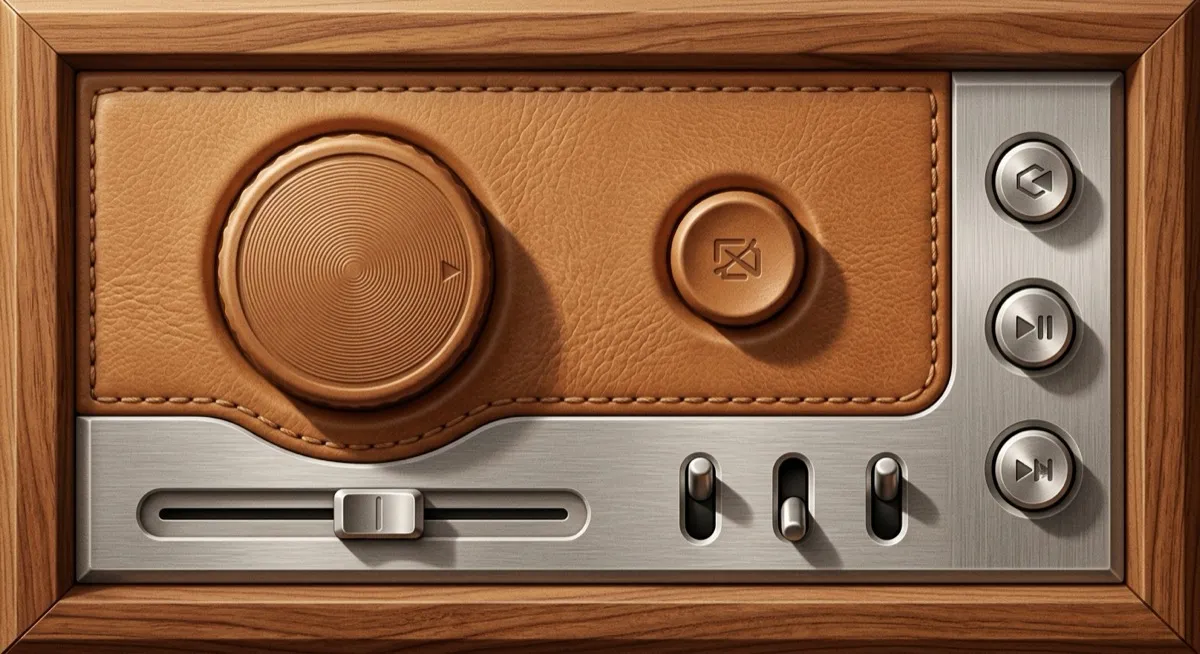
#e8e0d2#f6f0e4#2e2820#77451c#fff8ecMake the digital thing look like the physical thing it replaces, and people who have never used your interface already know how it works – a “save” icon shaped like a floppy disk borrows familiarity from an object users had actually touched. That instinct is skeuomorphism, and the stage above shows its modern form: not torn paper and stitched leather, but light behaving consistently across a warm material surface.
It reigned in mainstream software roughly 2007-2013, most visibly in early iOS, because it made touchscreens legible to people who had never used one. The watershed was iOS 7 in September 2013: Apple’s flat redesign ended the skeuomorphic era almost overnight, and the lineage note 09 traces – Dieter Rams through Jony Ive into flat design – took over for a decade.
The 2025-26 revival is real but partial, with three named drivers: minimalism fatigue (texture reads as fresh again), display technology catching up (realistic texture is now cheap to render), and a genuine usability argument – flat design’s lack of visual cueing can hide what’s interactive, and tactile cues help. Every source agrees on the shape of it: a flat foundation with selective tactile accents, not a return to fully-textured 2010 screens. (The usability-argument driver carries the note’s own hedge – it reads partly as post-hoc rationalisation.)
Teaching an unfamiliar interaction through familiarity with a physical object – still genuinely useful for onboarding novel input methods – and brand contexts wanting warmth, craft or tactility as a signal.
As a wholesale interface treatment in 2026. The revival is selective and hybrid; over-applying it reads as dated rather than fresh. If every surface has texture, none of it is saying anything.
Neumorphism – the monochrome abstraction of this idea: it keeps the extrude-and-press metaphor but drops the materials, the warmth and most of the accessibility. Claymorphism – soft volume without referencing any real material. All three fake depth with shadow technique; only skeuomorphism points at actual objects. For Apple’s current variant, the source note carries a dedicated vocabulary: translucent glass material, refraction and specular highlights, adaptive tint from clear to fully tinted, elevates and distinguishes foreground controls from content beneath.
The actual scope from style-scopes.css – the CSS that painted the stage above.
/* ===== style: skeuomorphism ===== */
/* Realism via light physics: one top light source, the four-layer shadow
   stack (contact + ambient + inset bevel + inset shade), warm material
   palette that never touches pure white or black. */
[data-style='skeuomorphism'] {
  --bg-page: #e8e0d2;
  --bg-raised: #f6f0e4;
  --bg-active: #ded4c2;
  --border-default: #857a66;
  --border-hover: #6d6250;
  --border-input: #857a66;
  --text-primary: #2e2820;
  --text-secondary: #5b5344;
  --accent-solid: #77451c;
  --accent-solid-hover: #5e3614;
  --accent-text: #6d3f18;
  --on-accent: #fff8ec;
  --radius-s: 8px;
  --radius-m: 12px;
  --radius-l: 16px;
  --shadow-1:
    0 1px 2px rgba(46, 40, 32, 0.28),
    0 3px 8px rgba(46, 40, 32, 0.16),
    inset 0 1px 0 rgba(255, 252, 245, 0.85),
    inset 0 -2px 3px rgba(46, 40, 32, 0.12);
  --shadow-2:
    0 2px 3px rgba(46, 40, 32, 0.3),
    0 6px 14px rgba(46, 40, 32, 0.2),
    inset 0 1px 0 rgba(255, 252, 245, 0.85),
    inset 0 -2px 3px rgba(46, 40, 32, 0.12);
  --font-sans: system-ui, -apple-system, 'Helvetica Neue', sans-serif;
}
.sty-card[data-style='skeuomorphism'],
[data-style='skeuomorphism'] .sty-panel {
  background-image: linear-gradient(180deg, #faf5eb 0%, #f6f0e4 55%, #efe7d7 100%);
}
[data-style='skeuomorphism'] .sty-btn {
  background-image: linear-gradient(180deg, #8f5a2c 0%, #77451c 55%, #66390f 100%);
  box-shadow: inset 0 1px 0 rgba(255, 248, 236, 0.35), 0 1px 2px rgba(46, 40, 32, 0.4);
  text-shadow: 0 -1px 0 rgba(46, 40, 32, 0.45);
}
/* Vignette: bevelled material bars under fine feTurbulence noise – the
   note's 0.04-0.06 opacity band, enough to read as surface, never dirt. */
[data-style='skeuomorphism'] .sty-art {
  background-image: linear-gradient(180deg, #efe8d9 0%, #e2d8c4 100%);
  border-color: #b3a68e;
}
[data-style='skeuomorphism'] .sty-art::after {
  content: '';
  position: absolute;
  inset: 0;
  pointer-events: none;
  opacity: 0.05;
  background-image: url("data:image/svg+xml,%3Csvg xmlns='http://www.w3.org/2000/svg' width='120' height='120'%3E%3Cfilter id='n'%3E%3CfeTurbulence type='fractalNoise' baseFrequency='0.8' numOctaves='2'/%3E%3C/filter%3E%3Crect width='120' height='120' filter='url(%23n)'/%3E%3C/svg%3E");
}
[data-style='skeuomorphism'] .sty-art > i {
  background-image: linear-gradient(180deg, #cfc3aa 0%, #b6a88b 100%);
  background-color: #b6a88b;
  box-shadow: inset 0 1px 0 rgba(255, 252, 245, 0.8), 0 1px 2px rgba(46, 40, 32, 0.35);
  opacity: 1;
}
[data-style='skeuomorphism'] .sty-art .sty-art-c {
  background-image: linear-gradient(180deg, #8f5a2c 0%, #66390f 100%);
}
/* Hover: the pressed state from the tell – shadow inverts, surface dips 1px. */
.sty-card[data-style='skeuomorphism']:hover {
  transform: translateY(1px);
  box-shadow:
    0 1px 1px rgba(46, 40, 32, 0.2),
    inset 0 2px 4px rgba(46, 40, 32, 0.18),
    inset 0 -1px 0 rgba(255, 252, 245, 0.6);
}
/* ===== end skeuomorphism ===== */Meant to be copied, not paraphrased – anchors beat adjectives when briefing an agent.
Named links out – the vignettes above are reconstructions, never screenshots (ADR #006).